Origins of Earth’s weird ‘pulsating auroras’ nailed down

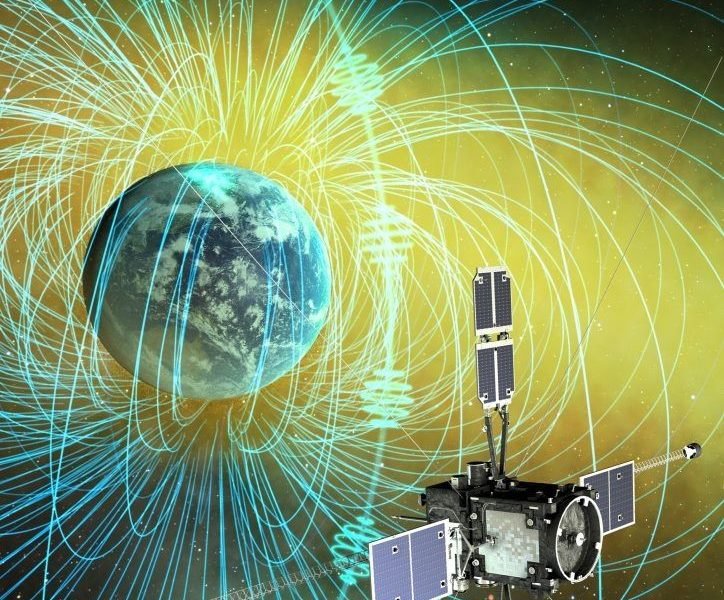
Japan’s Arase spacecraft (previously called ERG) observed chorus waves and spread electrons in Earth’s magnetosphere, the origin of pulsation auroras. The spread electrons sped up into the environment, leading to auroral lighting. ( ERG Science Team) The origins of extreme flickering screens of light high up in Earth’s environment are now exposed after a decades-long […]

Magnetic ‘cages’ on the Sun could limit the strength of dangerous solar flares

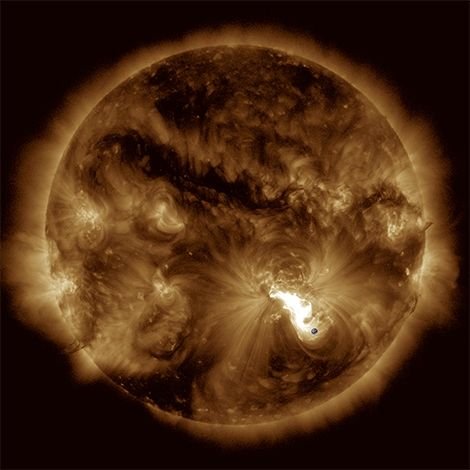
Major eruption ofOct 24, 2014, observed by the AIA instrument of the NASA Solar Dynamics Observatory objective. Earth was included for scale.(Copyright2018 Tahar Amari et al./ Centre de body théorique (CNRS/ École Polytechnique)) New research study might have recognized a system that restricts simply how effective surges from the sun can end up being, shedding […]

New tech could help astronomers see planets around Alpha Centauri

Our brilliant surrounding galaxy, Alpha Centauri, could harbor an Earth- size world– however new dives in innovation are required for us to see it.( ESO/DigitizedSky Survey 2 Acknowledgement: Davide De Martin) Technology in advancement could capture images from an Earth- size world in the close-by Alpha Centauri system in the 2020 s, new research study […]

Supersize stars may be more common than previously thought

The Tarantula Nebula, situated about 180,000 light-years from Earth in the surrounding galaxy called the Large Magellanic Cloud, hosts stars with the best masses yet spotted. New research study analyzing this nebula recommends huge stars are even more common than previously thought.( NASA, ESA, & & F. Paresce (INAF-IASF), R. O’Connell(U. Virginia), & & the […]

As the world turns: Life could speed up a planet’s spin

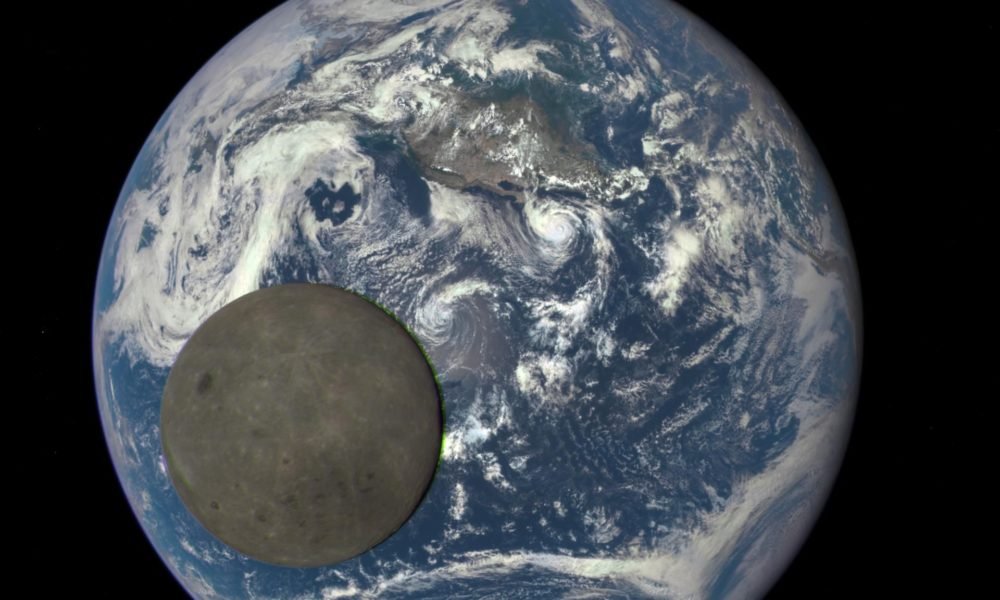
The length of Earth’s day is decreasing at a glacial rate of 1.8 milliseconds every 100 years. This image programs the Earth and moon as seen by NASA’s Deep Space Climate Observatory satellite 1 million miles away.( NASA/GSFC) The existence of life may affect how quick a world spins, launching gases such as oxygen that […]

Despite deadly rays, pulsars could host habitable planets

[ad_1] Artistic impression of a habitable world (center) near a pulsar (right). Such a world should have a massive environment that transforms the deadly X-rays and high-energy particles of the pulsar into heat. (Institute of Astronomy, University of Cambridge). Althoughpulsars routinely blast out deadly gamma rays and X-rays, alien planets in orbit around them could […]