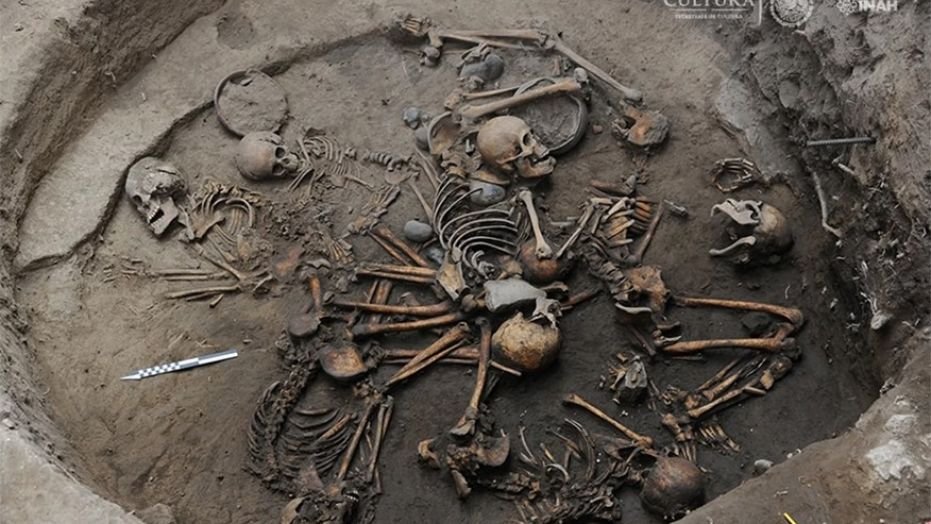
Archaeologists in Mexico City have actually found the burial of 10 skeletons set up in a spiral, with 2 of the skeletons revealing deliberate skull contortion. Credit: INAH
Modern- day MexicoCity is constructed on top of centuries of previous settlements, so it’s not uncommon for ancient burial places to sometimes be exposed underneath the city’s streets. It is, nevertheless, unusual to discover 10 ancient skeletons set up in a spiral with their bodies interlocked, as archaeologists just recently did.
The 2,400- year-old burial was found throughout salvage excavations of an ancient town underneath the school of the Pontifical University of Mexico, in southern Mexico City, the National Institute of Anthropology and History (INAH) revealed.
The archaeologists stated the burial is the “most peculiar finding” they have actually made considering that they started uncovering the ancient settlement of Tlalpan in2006 There has actually never ever been a tomb with a lot of people from this period (the Preclassic duration) found in the area, inning accordance with the declaration from INAH.
Video video footage from the excavation trench demonstrated how the archaeologists discovered the collection of human bones. Arranged in a circular tomb, 6.5 feet (2 meters) in size, the bodies had actually been buried with some severe products, consisting of stones and ceramic containers and bowls. The 10 people consist of males and women, primarily youths, along with a baby and a young child. [25 Grisly Archaeological Discoveries]
The scientists have actually not yet figured out the cause of death for the people or how they may be connected to one another, however they have actually observed some indications of body adjustment: deliberate skull deformationin 2 cases, and tooth mutilation in a couple of others. These practices– which may have included binding kids’s growing skulls with fabric and filing teeth into various shapes– prevailed amongst numerous cultures inMesoamerica [In Photos: Deformed Skulls Reveal Odd, Ancient Tradition]
The archaeologists believe the uncommon burial design was possibly part of an ancient routine. The age variety of the departed signals that the plan might signify the phases of life, the director of the excavations, Jimena Rivera, informed the news channel Televisa
The town of Tlalpan was amongst the earliest settlements to surface in the Basin of Mexico (likewise called the Valley of Mexico), INAH scientists stated. Close to the ancient coast of Xochimilco Lake, the town would have had plentiful freshwater, trees for building and construction and fertile soil for farming. This settlement lay east of Cuicuilco, a crucial metropolitan center at the time, understood for its pyramids. These websites preceded Teotihuacan, one of the most significant cities of the ancient world, which increased to its peak in the Basin of Mexico a couple of centuries later on, throughout the Classic duration.
Original post on LiveScience
.